

Surprising stat to start: a single ill-understood approval or blind-signed transaction is still one of the most common vectors for losing funds, even for experienced DeFi users. That persistent vulnerability is the reason Rabby — a DeBank-built, non-custodial, multi-chain wallet — has pushed transaction simulation and pre-signing risk scans to the center of its UX. For power users who move large sums, manage cross-chain positions, or run institutional workflows, that single design choice shifts the practical trade-offs between convenience and safety.
This piece is an analyst’s read of Rabby’s browser extension and surrounding ecosystem: how the simulation engine works in practice, what it solves (and doesn’t), how it compares to incumbents, and how to decide whether to add Rabby to a security stack for U.S.-based DeFi activity. I’ll explain mechanisms, highlight real limitations, and give a short, reusable checklist you can apply the next time you approve a contract or bridge funds.
Mechanics first: what Rabby’s simulation and risk scan actually do
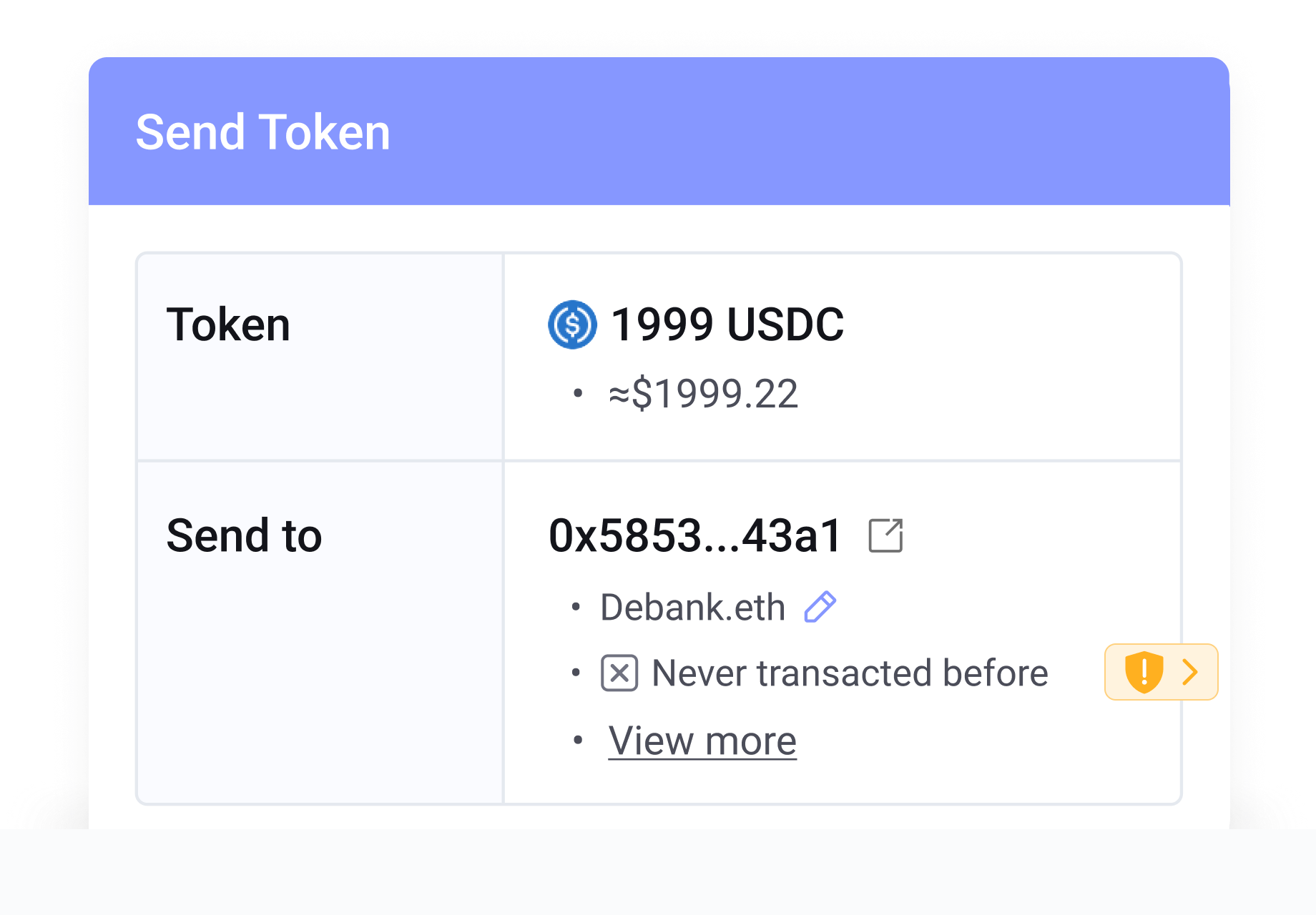
At a mechanism level Rabby interposes itself between a dApp’s transaction payload and your signature. Rather than presenting an opaque “sign” button, Rabby simulates the on-chain execution of the transaction locally and shows estimated token balance deltas and fee costs before you sign. That tackles the classic problem of blind signing: users cannot see the downstream state changes that a contract call will produce, so they may accidentally approve transfers or swaps that drain assets.
On top of simulation, Rabby runs a pre-transaction risk scan: it flags previously hacked contracts, suspicious multi-approval patterns, and non-existent recipient addresses. Those checks are not magic; they are rule- and indicator-based protections that reduce certain classes of human error and common attack patterns. Importantly, Rabby lets users see and revoke existing token approvals, so it closes a practical loop: detect risky approvals, then remove them.
What this design buys you — and what it doesn’t
Concrete benefits for power users. If you routinely interact with composable DeFi (liquidity pools, lending positions, multi-step swaps), seeing a simulated post-transaction balance helps you spot logic mistakes (e.g., a wrong token address or a slippage bug) before you sign. For institutional flows or multisig setups integrated with solutions like Gnosis Safe, Rabby’s compatibility with hardware wallets (Ledger, Trezor, Keystone and others) and enterprise custody providers (Fireblocks, Amber) means you can combine simulation with high-assurance key management.
Limits and boundary conditions. Simulation reduces, but does not eliminate, risk. It relies on accurate state reads and deterministic execution paths; complex contracts that call out to off-chain oracles, time-dependent logic, or gas-sensitive reentrancy windows may behave differently between a local simulation and real network execution. Likewise, a simulation can’t defend against social-engineering attacks (phishing sites that trick users into revealing seed phrases) or bugs in the wallet itself. Rabby’s 2022 incident — a Rabby Swap contract exploit that cost roughly $190k — is a sober reminder: even projects that prioritize security can suffer smart-contract failures. The team froze the contract and compensated users, and they beefed up audits afterwards, but the episode illustrates the persistent risk of code complexity in DeFi.
How Rabby fits into a multi-wallet, multi-chain workflow
Rabby’s multi-chain support (over 90 EVM-compatible chains) and automatic network switching address two operational frictions that trip up active DeFi users: managing gas across chains and accidentally interacting with a contract on the wrong network. The wallet’s cross-chain gas top-up feature is a pragmatic convenience — you can send ETH or BNB to a network that lacks funds so a bridging or liquidation transaction can go through — which matters if you run arbitrage or liquidation bots across L2s.
That said, Rabby intentionally does not pretend to be a one-stop fiat/cefi on-ramp: it lacks a built-in fiat purchase flow and native staking tools. If your workflow requires buying crypto with USD inside the wallet or staking seamlessly inside the UI, you’ll need external services. For many advanced users in the U.S., that separation is acceptable — they prefer specialized custody, compliance, and fiat rails — but it is important to note for anyone evaluating convenience costs.
Comparisons and decision heuristics: when Rabby makes sense
Compared with major alternatives (MetaMask, Trust Wallet, Coinbase Wallet), Rabby’s explicit differentiator is pre-signing transparency. MetaMask is ubiquitous and well-integrated across dApps; Rabby’s “Flip” toggle even lets you swap which wallet acts as the default in your browser. The trade-off is subtle: Rabby surfaces more information and security checks at the cost of slightly more friction during transaction approval. For power users that friction is deliberate and valuable — the cognitive overhead of reading a simulation beats recovering from a stolen approval.
Decision heuristic — a three-question test: 1) Do you routinely sign complex, multi-step DeFi transactions or manage cross-chain positions? If yes, simulation is high value. 2) Do you rely on hardware keys or institutional custody for signing? Rabby’s compatibility with Ledger/Trezor and integrations like Gnosis Safe make it complementary. 3) Do you need fiat on-ramp and in-wallet staking? If yes, Rabby alone won’t meet those needs. If you answer yes to 1 and 2 and no to 3, Rabby is a strong candidate.
One sharper mental model: risk reduction vs. risk elimination
Here’s a useful way to think about wallets: they provide two categories of protection — preventive controls (things that block or deter dangerous transactions) and detective controls (things that alert you after the fact). Rabby is primarily preventive: simulations and pre-signing scans aim to stop unsafe approvals before they leave your browser. Revocation tools are partly detective (they reveal past approvals) but become preventive when you act to remove exposure. No wallet, however, converts prevention into certainty. The correct mental model is risk reduction through layered defenses: hardware keys, careful UX that reveals intent (Rabby), approved multisig policies, and operational hygiene (seed phrase handling, phishing avoidance).
What to watch next — signals that matter
Monitor three signals if you’re weighing long-term adoption: 1) audit cadence and independent security reviews of Rabby’s open-source codebase, 2) how well Rabby’s simulation handles increasingly complex DeFi composability (does it correctly model oracle-fed and time-sensitive contract behaviors?), and 3) product integration with institutional compliance tooling in the U.S. — for example, stronger enterprise-level RL control or policy enforcement for regulated entities. These will determine whether Rabby remains primarily a power-user tool or scales into regulated institutional operations.
For a concise overview and installation resources tailored to users who want to test Rabby in a browser context, see this page: https://sites.google.com/cryptowalletextensionus.com/rabby-wallet/
FAQ
How reliable are Rabby’s transaction simulations?
Simulations are a strong preventive control for deterministic, on-chain logic: swaps, token transfers, and standard DeFi interactions. They can be less reliable for contracts that depend on off-chain data, oracle timing, or gas-related race conditions. Treat simulation as a high-quality signal, not an absolute guarantee.
Can Rabby replace a hardware wallet or multisig for institutional security?
No single product is a full institutional security posture. Rabby integrates with hardware wallets and multisig solutions (e.g., Ledger, Gnosis Safe), which is its intended role: to add situational awareness and revoke approvals while delegating key custody and policy enforcement to specialized tools.
What happened in Rabby’s 2022 incident and why does it matter?
A smart contract tied to Rabby Swap was exploited, causing roughly $190k in losses. The team froze the contract and compensated users, then increased audits. The incident matters because it illustrates that even security-focused products can be exposed through complex contract logic — underscoring why simulation and revocation tools are valuable but not sufficient alone.
Is Rabby legal and safe to use in the United States?
Rabby is a non-custodial software wallet and is generally legal to use in the U.S.; users remain responsible for compliance with tax and reporting rules. Safety depends on following operational best practices (secure seed storage, hardware wallets for large balances, avoiding phishing sites) and understanding that software alone cannot eliminate all smart-contract risk.
Takeaway for a U.S. DeFi power user: Rabby is a purposeful tool that reframes the signing step — turning a common point of failure into an explicit decision point. That design matters when value is large, positions are cross-chain, or institutional controls are required. If you treat it as one layer in a defense-in-depth strategy — paired with hardware keys, multisig, and careful operational procedures — Rabby materially changes the cost-benefit calculus of interacting with complex DeFi protocols. But don’t mistake simulation for invulnerability; it’s an important guardrail, not a substitute for careful engineering and audits.